




Why Choose Folding Boxes? A Practical Guide to Space-Saving Packaging
Sep 29, 2026
Leave a message
For brands buying packaging internationally, the box itself is only part of the calculation.
A packaging structure also affects shipping volume, warehouse storage, assembly time, material consumption, printing options, and the final presentation of the product.
This is where folding boxes can be useful.
Unlike rigid boxes that are normally transported in their assembled form, many folding box structures can be produced, shipped, and stored flat before they are assembled. This can reduce occupied volume across the supply chain and give brands more flexibility when managing packaging inventory.
Our original packaging research identified the same practical advantages: flat-packed transportation, easier storage, assembly efficiency, customization, and a range of printing and finishing options.
At Shenzhen Zhengyuan Paper Technology Co., Ltd., we approach folding-box projects from the production side. We look at the product dimensions, structure, material, printing, finishing, assembly method, and logistics requirements before recommending a packaging configuration.
The objective is not simply to make a box that looks good.
It is to develop a box that can be manufactured, transported, stored, assembled, and used as intended.
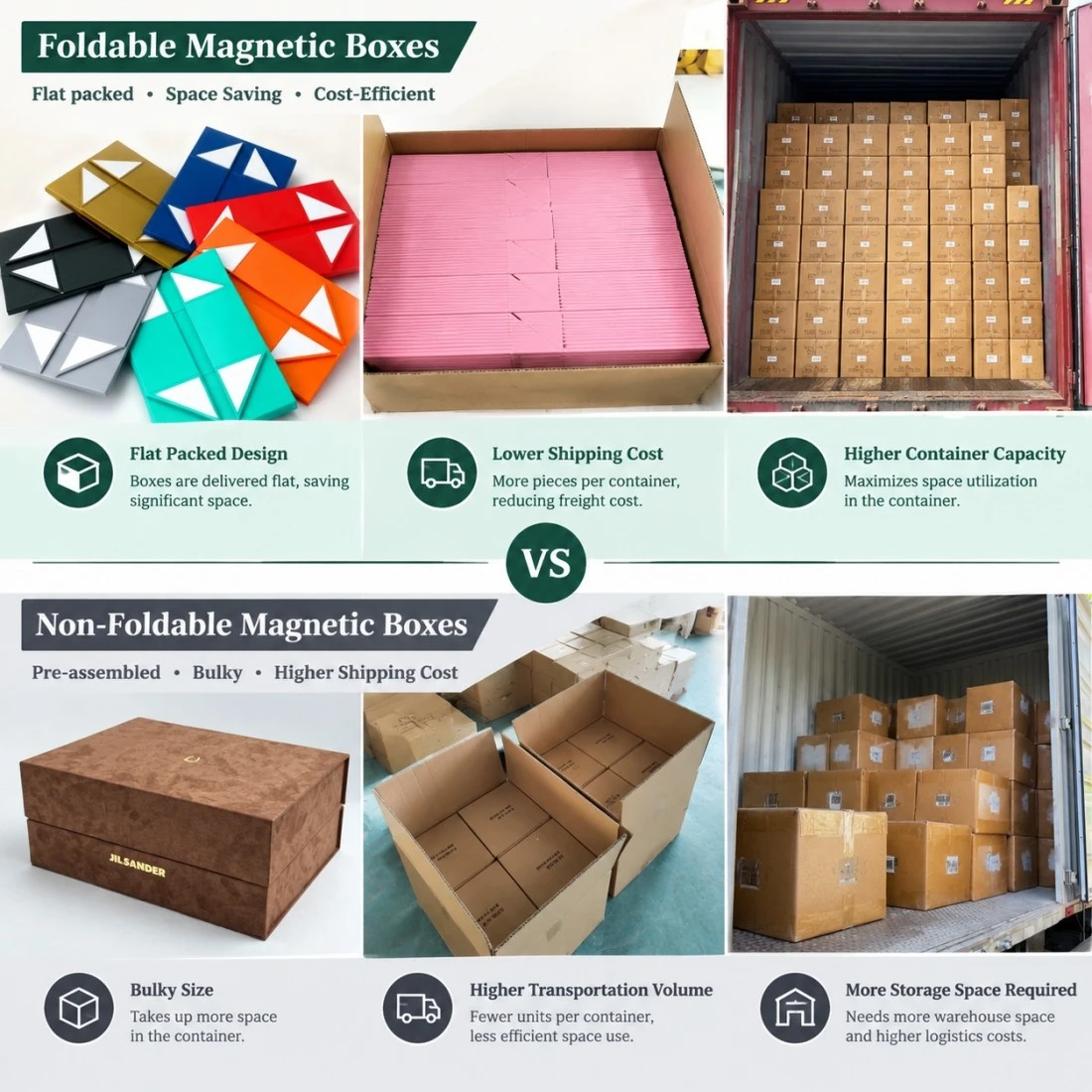
1. Folding Boxes Can Reduce Shipping Volume
One of the most practical reasons brands consider folding boxes is their flat-packed structure.
A conventional rigid box is generally transported as an assembled structure. That means the internal empty space of the box also occupies shipping and warehouse volume.
A folding box can be supplied flat and assembled later.
This changes the logistics calculation.
For an international packaging project, the supply chain may include:
- Box production
- Quality inspection
- Export packing
- International transportation
- Warehouse storage
- Box assembly
- Product filling
- Final distribution
If the packaging occupies less volume before assembly, the brand can potentially use storage and transportation space more efficiently.
The actual saving depends on the box structure, finished dimensions, shipping method, packing configuration, and order quantity. Therefore, we do not recommend publishing a fixed percentage of "shipping cost savings" unless it has been calculated for a specific project.
What we check during packaging development
For a folding box project, our team can evaluate:
- Flat dimensions
- Assembled dimensions
- Board specification
- Folding lines
- Gluing areas
- Packing quantity per carton
- Carton dimensions
- Pallet configuration
- Shipping requirements
This makes the logistics discussion more measurable than simply saying that a box is "space-saving."
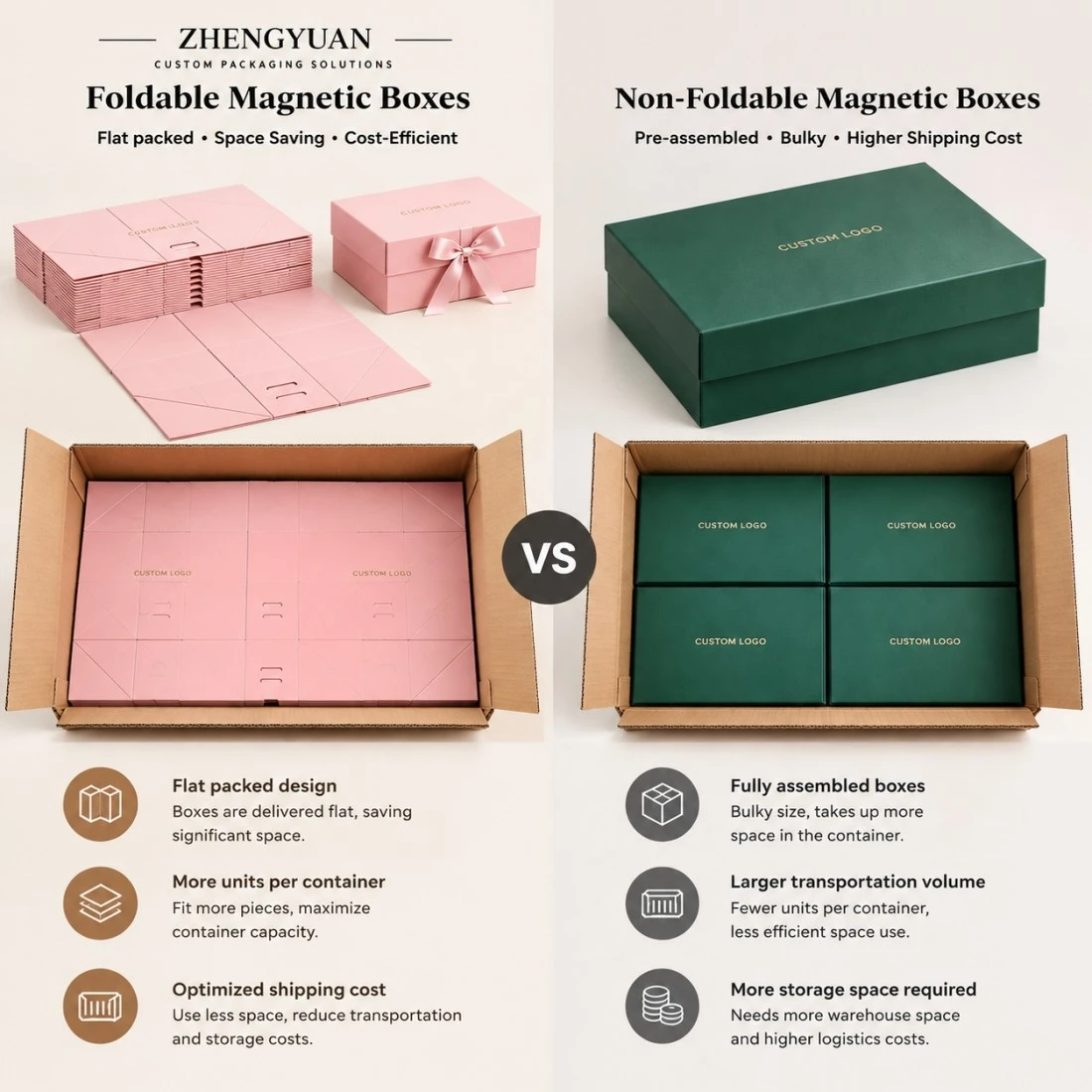
2. Folding Boxes Can Simplify Warehouse Storage
Packaging inventory can become a problem when boxes arrive months before the finished product is ready.
Fully assembled boxes take up physical space even when they are not being used.
Flat-packed folding boxes provide another option.
Brands can store the packaging in its flat state and assemble the required quantity closer to the packing stage.
This can be particularly useful for:
- Seasonal products
- Promotional packaging
- New product launches
- E-commerce brands
- Retail packaging
- International distribution
However, storage requirements still depend on the board material, carton packing method, humidity conditions, and warehouse environment.
So the correct question is not simply:
"How much warehouse space will folding boxes save?"
It is:
"How does the selected folding structure change the packed volume of this specific project?"
That is the calculation we recommend making before production.
3. Folding Boxes Can Improve Packaging Assembly Efficiency
A folding box is designed around its crease lines, locking points, glue areas, and opening structure.
The assembly method therefore needs to be considered during structural development rather than after the box has already been produced.
Common folding structures include:
- Tuck-end boxes
- Auto-lock bottom boxes
- Sleeve structures
- Window folding boxes
- Custom locking structures
- Multi-panel folding structures
The best structure depends on the product dimensions, product weight, opening experience, packing method, and required production process.
Our source material highlights the same production considerations: folding structure, assembly convenience, product security, and production efficiency.
Why assembly needs to be tested
A box can look correct on a computer screen and still create problems during actual assembly.
For example:
- A locking tab may be too tight.
- A folding line may require excessive force.
- A glue area may interfere with the product.
- A window may affect structural strength.
- A deep structure may be difficult to assemble manually.
- An automatic packing line may require different tolerances.
For this reason, prototype assembly is an important part of folding-box development.

4. Material Selection Should Match the Product
There is no single paperboard specification that is correct for every folding box.
The material should be selected according to the product and the required performance.
Typical considerations include:
- Product weight
- Box dimensions
- Structural complexity
- Printing requirements
- Surface appearance
- Folding performance
- Finishing requirements
- Storage conditions
- Sustainability requirements
Common material categories include:
- Coated paperboard
- Specialty paper
- Kraft paper
- Textured paper
- Recycled paperboard
FSC-certified paper, where applicable and properly documented
A note about GSM and board thickness
This is an area where packaging content often uses misleading "standard values."
For example, saying:
"All folding boxes use 300 GSM board."
would not be technically accurate.
ISO 536:2019 provides a standardized method for determining paper and board grammage. It does not specify one universal grammage for all packaging applications.
Similarly, ISO 534:2011 specifies methods for measuring paper and board thickness, density and specific volume.
Therefore, the specification should be written according to the actual project:
Board grammage: [INSERT PROJECT VALUE] GSM - verify against approved material specification.
Board thickness: [INSERT PROJECT VALUE] mm - verify against approved material specification.
This is more useful to a professional packaging buyer than publishing an arbitrary "industry standard."
5. Printing and Finishing Can Change the Final Packaging Result
A folding box does not have to look like a basic retail carton.
Depending on the structure and material, brands can use different printing and finishing combinations.
Printing options
- CMYK process printing
- Spot/Pantone color printing
- Interior printing
- Custom artwork
- Text and barcode printing
- Image reproduction
Finishing options
- Hot foil stamping
- Embossing
- Debossing
- Spot UV
- Matte lamination
- Gloss lamination
- Soft-touch coating
- Specialty paper
- Die-cut windows
Our source material identifies these same printing and finishing options as part of folding-box customization.
The important point is that finishing should be considered together with the paperboard and printing method.
For example, a dark specialty paper with metallic foil creates a different result from CMYK printing on coated board.

6. Color Control Matters for Brand Packaging
Color consistency is particularly important when packaging carries a recognizable brand color.
A brand may specify a particular CMYK combination, Pantone reference, or approved physical sample.
However, the printed result can be affected by:
- Paperboard
- Surface coating
- Ink
- Printing process
- Color separation
- Press conditions
- Finishing
- Viewing conditions
ISO 12647-2:2013 provides process-control references for four-colour offset printing and includes printing on cardboard packaging substrates. A new edition is currently under development.
For packaging projects where color is commercially important, we recommend confirming the following before mass production:
- Artwork color specification
- Paperboard specification
- Printing method
- Color reference
- Proofing method
- Approved sample
- Final production reference

7. Folding Boxes Can Be Customized for Different Product Categories
The same basic folding-box concept can be adapted for different products.
At Zhengyuan, folding-box applications include packaging for:
- Perfume
- Cosmetics
- Skincare
- Candles
- Food
- Chocolate
- Gifts
- Retail products
The structural requirements are different for each category.
Perfume Packaging
Perfume boxes often require attention to:
- Bottle dimensions
- Product weight
- Internal clearance
- Premium paper
- Brand color
- Foil stamping
- Embossing
- Opening structure
Cosmetic Packaging
Cosmetic boxes may need:
- Compact dimensions
- Clear product information
- Barcode placement
- Retail shelf visibility
- Efficient packing
- Consistent color reproduction
Candle Packaging
Candle packaging may require:
- Larger internal dimensions
- Product protection
- Structural stability
- Specialty paper
- Window options
- Gift-oriented presentation
The important point is that a folding box should be developed around the product rather than forcing every product into the same structure.

8. Folding Box vs. Rigid Box: What Should You Compare?
There is no universal answer for which structure should be used.
The decision should be based on the product, logistics, assembly process, quantity, and desired presentation.
|
Factor |
Folding Box |
Rigid Box |
|
Shipping format |
Usually flat-packed |
Usually assembled |
|
Pre-assembly volume |
Lower |
Higher |
|
Warehouse storage |
Flat storage possible |
Requires more assembled volume |
|
Assembly |
Requires folding/assembly |
Usually arrives formed |
|
Structure |
Flexible |
Structurally rigid |
|
Printing |
CMYK, spot color, specialty finishes |
CMYK, spot color, specialty finishes |
|
Premium presentation |
Depends on material and finishing |
Strong structural presentation |
|
Logistics efficiency |
Often an important advantage |
Depends on design |
|
Suitable applications |
Retail, cosmetics, perfume, food, gifts |
Luxury gifts, premium sets, rigid presentation |
The source material similarly compares the two formats based on shipping space, storage, assembly, production efficiency and applications.
Rather than calling one format universally better, we recommend matching the structure to the actual project requirements.
9. Folding Boxes and Sustainability
Paper-based packaging can provide several options for brands working on packaging sustainability.
These may include:
- Paperboard-based structures
- Recycled paper materials
- FSC-certified materials where applicable
- Reduced transport volume through flat packing
- Structural designs that avoid unnecessary material
Folding-carton industry guidance also recognizes the role of paperboard packaging in shipping, storage, product presentation and recyclability, while noting that coatings and laminated structures can affect the material configuration.
FSC certification should also be described precisely. FSC Chain of Custody certification concerns the sourcing, processing, labeling and sale of forest-based products as FSC-certified products.
Therefore, we recommend avoiding a blanket statement such as:
"All our boxes are environmentally friendly."
A more accurate statement is:
"FSC-certified and recycled paper options are available for applicable packaging projects, subject to material availability and certification requirements."

10. How We Develop a Folding Box at Zhengyuan
Our production experience tells us that packaging problems are easier to solve before mass production than after production has started.
Our typical development workflow is:
Step 1 - Understand the Product
We confirm:
- Product dimensions
- Product weight
- Shape
- Quantity
- Packing method
- Market requirements
Step 2 - Develop the Structure
We evaluate:
- Folding lines
- Opening method
- Locking points
- Glue areas
- Product clearance
- Flat-packed dimensions
Step 3 - Select Materials
The board and paper combination is selected according to:
- Required structure
- Printing
- Surface appearance
- Product weight
- Finishing requirements
Step 4 - Create the Prototype
The prototype allows us to check:
- Actual dimensions
- Folding performance
- Assembly
- Product fit
- Visual appearance
Step 5 - Confirm Artwork and Finishing
Before production, the project should have an approved artwork and confirmed specifications.
Step 6 - Mass Production
The approved specification becomes the production reference.
Step 7 - Quality Inspection
Inspection focuses on relevant characteristics such as:
- Dimensions
- Printing
- Color
- Die cutting
- Folding
- Gluing
- Surface finishing
- Assembly
- Packing
This production-stage approach is consistent with the process described in the supplied source, which covers concept development, structural design, prototype production, manufacturing and delivery support.

11. Quality Management and Compliance: What Buyers Should Verify
Packaging buyers often see terms such as ISO, FSC, CE and RoHS on supplier websites.
These terms should not be treated as interchangeable.
ISO 9001
ISO 9001 is a quality management system standard. The current edition is ISO 9001:2026. It focuses on establishing, maintaining and continually improving a quality management system.
Publication rule:
Only state that Zhengyuan is ISO 9001 certified if the current certificate has been checked before publication.
FSC
FSC certification relates to responsibly sourced forest-based materials and chain of custody.
Publication rule:
Only make FSC-certified material or chain-of-custody claims when the applicable certificate and product scope have been verified.
CE
CE marking is not a general certification for paper packaging. EU guidance states that CE marking applies to products covered by specific EU harmonisation legislation.
RoHS
RoHS regulates certain hazardous substances in electrical and electronic equipment. It should not be presented as a general certification for ordinary paper boxes.
This distinction is important because accurate compliance information builds more trust than putting multiple certification logos on a packaging page without explaining what they actually apply to.
12. Our Manufacturing Information
For transparency, the company information used in this article should be published only after the current company profile has been checked.
Company: Shenzhen Zhengyuan Paper Technology Co., Ltd.
Established: 2006 - [HUMAN VERIFY]
Packaging experience: 20+ years - [HUMAN VERIFY]
Factory area: 6,000+ m² - [HUMAN VERIFY]
Production machines: 20 - [HUMAN VERIFY]
Employees: 150+ - [HUMAN VERIFY]
Clients: 500+ - [HUMAN VERIFY]
Annual production capacity: [INSERT VERIFIED FIGURE]
We deliberately recommend publishing the annual capacity only after the production team provides a current figure.
A capacity number without a defined unit-such as pieces/year, boxes/year, or production value/year-does not provide useful information to a packaging buyer.

13. MOQ, Lead Time and Quality Policy
Packaging buyers normally want three practical answers before sending an inquiry:
How many can I order?
How long will production take?
What happens if there is a quality problem?
Instead of publishing universal numbers that may not apply to every project, we recommend presenting these terms transparently.
MOQ
MOQ: [INSERT CURRENT MOQ] units per structure/design
If the MOQ varies according to size, material, printing or finishing, state that clearly.
For example:
MOQ varies by box structure, material and finishing requirements. Please confirm the project specification for an exact MOQ.
Production Lead Time
Standard production lead time: [INSERT VERIFIED RANGE] working days after final artwork and specification approval.
Do not publish "15 days" or "20 days" as a universal promise unless production has confirmed that it applies to the relevant product category.
Sample Lead Time
Sample lead time: [INSERT VERIFIED RANGE] working days.
Quality Policy
Quality claim / replacement policy: [INSERT ACTUAL COMPANY POLICY].
This section should describe the actual process rather than using phrases such as "100% guaranteed quality."
14. Who Should Consider Folding Boxes?
Folding boxes may be particularly relevant when a brand needs several of the following:
- Flat-packed transportation
- Lower pre-assembly volume
- Flexible storage
- Efficient assembly
- Custom printing
- Brand-color control
- Specialty paper
- Premium finishing
- Retail presentation
- International packaging supply
They can be used for:
- Perfume
- Cosmetics
- Skincare
- Candles
- Chocolate
- Food
- Gifts
- Retail products
The right structure still depends on the product and the intended supply-chain process.

15. Frequently Asked Questions
Q: Are Folding Boxes Cheaper To Ship?
A: They can reduce occupied shipping volume because many folding boxes are transported flat before assembly. However, actual freight savings depend on box dimensions, packing configuration, shipment quantity and shipping method.
Q: Do Folding Boxes Require Assembly?
A: Yes. Most folding-box structures are designed to be folded or assembled before the product is packed. The exact assembly process depends on the structure.
Q: What GSM Should I Use For A Folding Box?
A: There is no single GSM that applies to every folding box.
Paper and board grammage is measured according to ISO 536:2019, but the appropriate specification depends on the box dimensions, structure, product weight and production requirements.
Q: What Thickness Should Folding-Box Board Be?
A: The required thickness is project-specific. ISO 534:2011 provides methods for determining paper and board thickness, but does not establish one universal thickness for every folding carton.
Q: Can Folding Boxes Look Premium?
A: Yes. Printing, specialty paper, foil stamping, embossing, debossing, spot UV and lamination can all be incorporated depending on the structure and material.
Q: Are Folding Boxes Recyclable?
A: Paperboard folding cartons can be recyclable, but recyclability depends on the specific material construction, coatings, laminates, inks and local recycling systems. ECMA notes that folding cartons can provide recycling advantages while also recognizing that material configurations matter.
Q: Can You Provide FSC-Certified Paper?
A: [HUMAN REVIEW REQUIRED]
Publish only the FSC claim and certificate details that are currently valid and applicable to the material being supplied.
Q: Do Your Boxes Have CE Or RoHS Certification?
A: CE and RoHS should not be presented as general certifications for ordinary paper packaging. CE applies to products covered by relevant EU legislation, while RoHS addresses hazardous substances in electrical and electronic equipment.
16. Folding Boxes vs. Rigid Boxes: The Practical Decision
The decision should start with the supply chain rather than the appearance alone.
Choose a folding structure when your project places greater emphasis on:
- Flat-packed transportation
- Storage efficiency
- Assembly
- Retail packaging
- Flexible printing
- Higher shipment volume
- Custom structural development
Consider rigid structures when the project requires:
- A permanently rigid form
- A more substantial unboxing structure
- Premium gift presentation
- Complex inserts
- A presentation box that arrives assembled
The correct packaging format depends on the product, quantity, logistics and customer experience requirements.
Conclusion: Design the Box Around the Entire Supply Chain
A folding box is more than a piece of printed paperboard.
Its structure affects:
Production → Packing → Shipping → Storage → Assembly → Product Presentation
That is why folding-box development should start with the product and supply-chain requirements rather than simply choosing a box style from a catalogue.
At Shenzhen Zhengyuan Paper Technology Co., Ltd., our approach is to evaluate the structure, material, printing, finishing, assembly and production requirements together.
For each project, the practical questions are:
- What product will the box hold?
- What are the finished dimensions?
- How will it be assembled?
- How will it be shipped?
- How will it be stored?
- What material specification is required?
- What printing process is appropriate?
- Which finishing techniques are needed?
- What quality reference will be approved before mass production?
Once these points are confirmed, the folding-box structure can be developed around measurable requirements rather than generic packaging claims.
If you are developing a new folding box, send us your product dimensions, box size, artwork or reference sample. We can review the structure and production requirements with you.
Send Inquiry